Not Another Web Design Company
We don't build websites to prove that a company has a website.
WebDesignBangalore.net is built for businesses that have something worth saying, selling or becoming — but whose website does not represent the quality of the business behind it.
We are deliberately not a volume agency. We do not want every project. We want the right projects: businesses that are willing to look at the evidence, understand the gaps, and invest in getting the digital foundation right.
The Website Problem We Keep Seeing
Too many good businesses are being represented by bad websites.
Across industries, we keep seeing the same pattern: bloated templates, fractured technical setups, confusing navigation, weak content, poor mobile experiences and websites that look acceptable in a screenshot but fail when real people and search engines interact with them.
The painful part is that many of these websites belong to companies that are much bigger, more capable and more authoritative than their online presence suggests.
A redesign should not simply replace the wallpaper. It should fix the reasons the old website was failing in the first place.
Digital Engineering, Not Decoration
A website has to work for two very different audiences.
One is human. The other is a search engine.
Humans need clarity, hierarchy, trust, easy navigation, useful information and a reason to act. Search engines need a structure they can understand, crawl and interpret. Businesses need both — along with speed, stability, maintainability and a sensible path from visitor to customer.
That is what we mean when we use the term Digital Engineering: well-thought web design, logic-based navigation, deliberate colour psychology, strong information architecture, fast and stable pages, search-friendly structure and an experience that makes sense from the user's point of view.
The design is the visible part. The engineering underneath it is what makes the visible part useful.
How We Look At A Website
We don't look at it from only one pair of eyes.
When evaluating a website, we deliberately change roles. We become the person who knows nothing about the technology. Then the impatient customer. Then the critical customer. Then the person who understands technology. Then the search engine trying to make sense of the page.
That role-playing changes what we notice.
A conventional web project can become a checklist: design it, develop it, launch it, invoice it. Our focus is different. The website is a product the client has to live with after launch. Its primary job is to achieve the reason it was built in the first place — whether that is generating enquiries, selling products, establishing authority, attracting search traffic or making a business easier to trust.
Before Websites Became Easy
In 2001, a website meant a modem, FTP and patience.
The first website I built was for my college during the first year of my Diploma in Instrumentation Technology. It lived on Yahoo GeoCities.
This was a very different web. Dial-up connections were slow and unreliable. Internet outages were normal. GeoCities offered a basic WYSIWYG editor, but serious editing often meant working with the actual page files: downloading them through FTP, changing the content or metadata, and uploading them again.
There were no modern CMS workflows, visual builders or one-click deployments making the process comfortable. The web demanded a little more technical involvement from the person building it.
That environment was where the journey started. Today's uninterrupted internet feels like a seven-star luxury by comparison.
SEO Before It Became An Industry
The first SEO project arrived because knowing a meta title was almost enough to get noticed.
Around 2002–2003, a Chennai-based web design company needed help with SEO but did not have the manpower or capability to deliver it. I had met a person called Padmanabhan through an online Q&A/forum community and, because I already understood things such as SEO titles and descriptions, I was considered for the work.
Tools such as Internet Business Promoter (IBP) helped bring some process to the work. The search landscape itself was dramatically simpler than it is today. For niche websites, carefully written titles, descriptions and headings could sometimes move a page to the top of Google.
That simplicity did not last. Search became more sophisticated, websites became larger, competition increased and technical architecture became inseparable from search performance.
What stayed useful was the habit of asking a simple question: what does the machine need to understand, and what does the human need to see?
Eleven Years Inside Bangalore's Digital Ecosystem
The corporate years taught us something valuable: process matters — but freedom matters too.
Over eleven years of professional work in Bangalore, I worked across search, website architecture, analytics, digital marketing and ecommerce environments.
Some organisations were heavily process-driven. Decisions around URLs, page management and content could be constrained by layers of approval. Other companies, particularly startups, gave much more freedom to experiment and cared primarily about outcomes.
Both environments taught useful lessons: how large teams operate, how decisions affect search and website architecture, how different functions depend on one another, how to work with data, and how much better a digital product can become when the people responsible for it are trusted to make informed decisions.
A Career Built Across Very Different Businesses
Different companies. Different constraints. The same website fundamentals.
The roles and environments varied considerably. That variety is part of the experience we bring to a project today.
AOL
A major digital environment that formed part of the broader search and web experience.
Norton
Experience within a globally recognised technology and security brand.
Yahoo
The most challenging role: SEO Analyst. The work centred on internal linking, information architecture and reporting. I moved on after three months.
Jabong
The most interesting role from a work perspective. Ecommerce was booming, traffic was rising, and A/B testing, analytics and data-driven decision-making were becoming central — often without the sophisticated tooling available today.
Aryaka Networks
A funded WAN-optimization technology startup in J.P. Nagar. CEO Ajith Gupta was exceptionally open to new ideas and gave real freedom around website decisions. The work culture was a lesson in what an empowered team can accomplish.
Zivame
A short engagement with a limited learning curve and repetitive work; I moved on quickly.
Trigent
A reminder that organisations can create strange constraints. SEO goals included terms such as offshore IT team and SharePoint development India, while even basic design tooling such as Adobe Photoshop was not provided to the people expected to produce the work.
The Search Agency
A US-based SEO agency where I worked with large US brands. The US-based Web Architecture team was highly professional and played a major role in helping me up-skill.
Zansaar
An ecommerce startup focused on home and kitchenware. As Head of SEO, I managed the website end-to-end with the content, social media, design, technology, email marketing, analytics and data teams.
The Work Outside The Job Title
The learning never stayed inside office hours.
Alongside full-time roles, I also worked as an independent SEO consultant on weekends, including SEO work outsourced by web design companies in the United States.
That combination — working inside companies while also seeing projects from the outside — helped build a useful perspective: a website is simultaneously a technical product, a search asset, a marketing channel and a business interface.
Roles Held
The titles changed. The responsibility kept moving closer to the whole digital product.
- SEO Manager
- Website Architecture Analyst
- Web Search and Data Analyst
- Digital Marketing Head
- VP of Digital Marketing
Evidence Matters
A couple of milestones worth documenting.
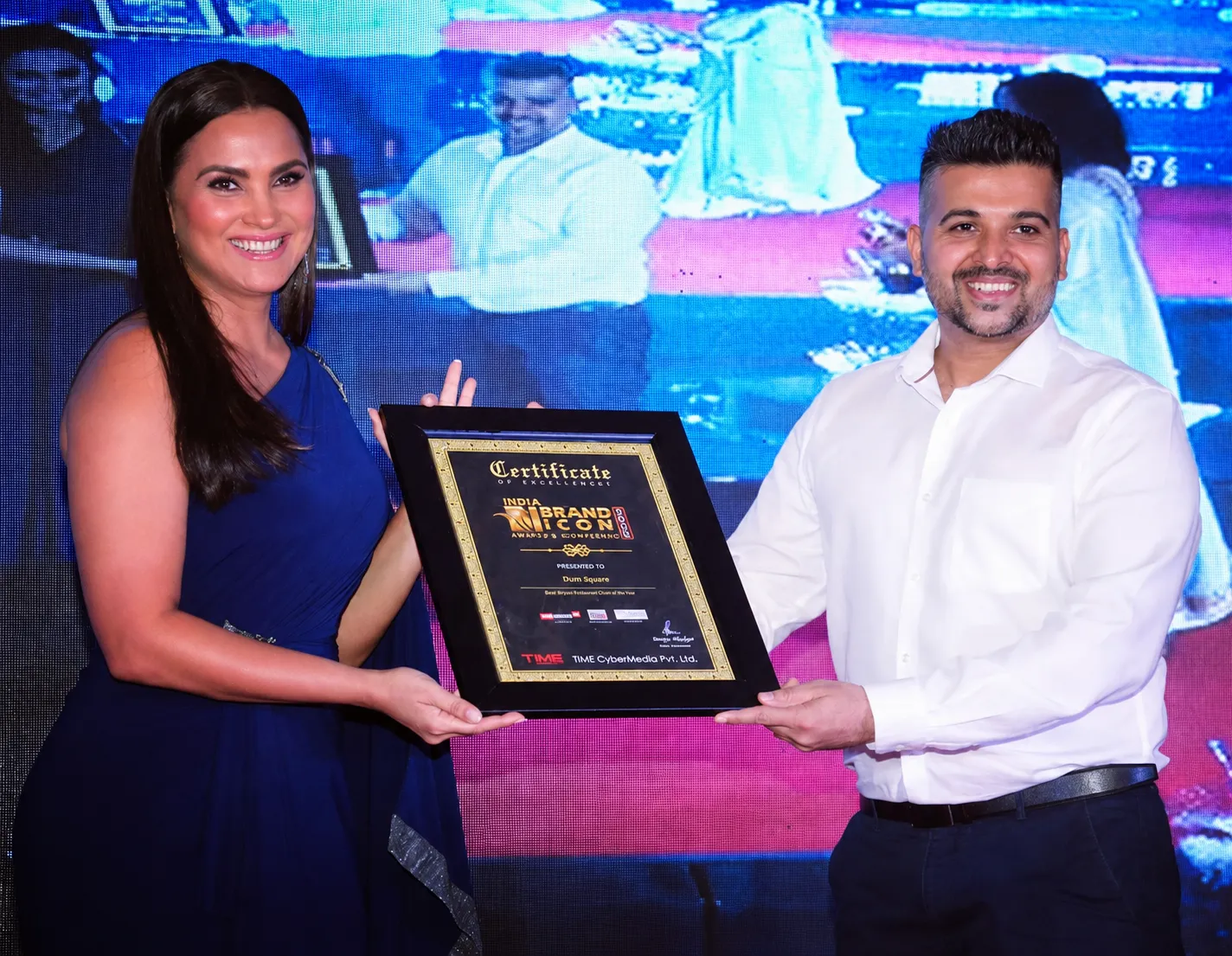
India Brand Icon 2020
A professional recognition moment organised by Time Cyber Media, received at an awards ceremony with Lara Dutta. We treat it as exactly what it is: a milestone and recognition — not a technical certification.
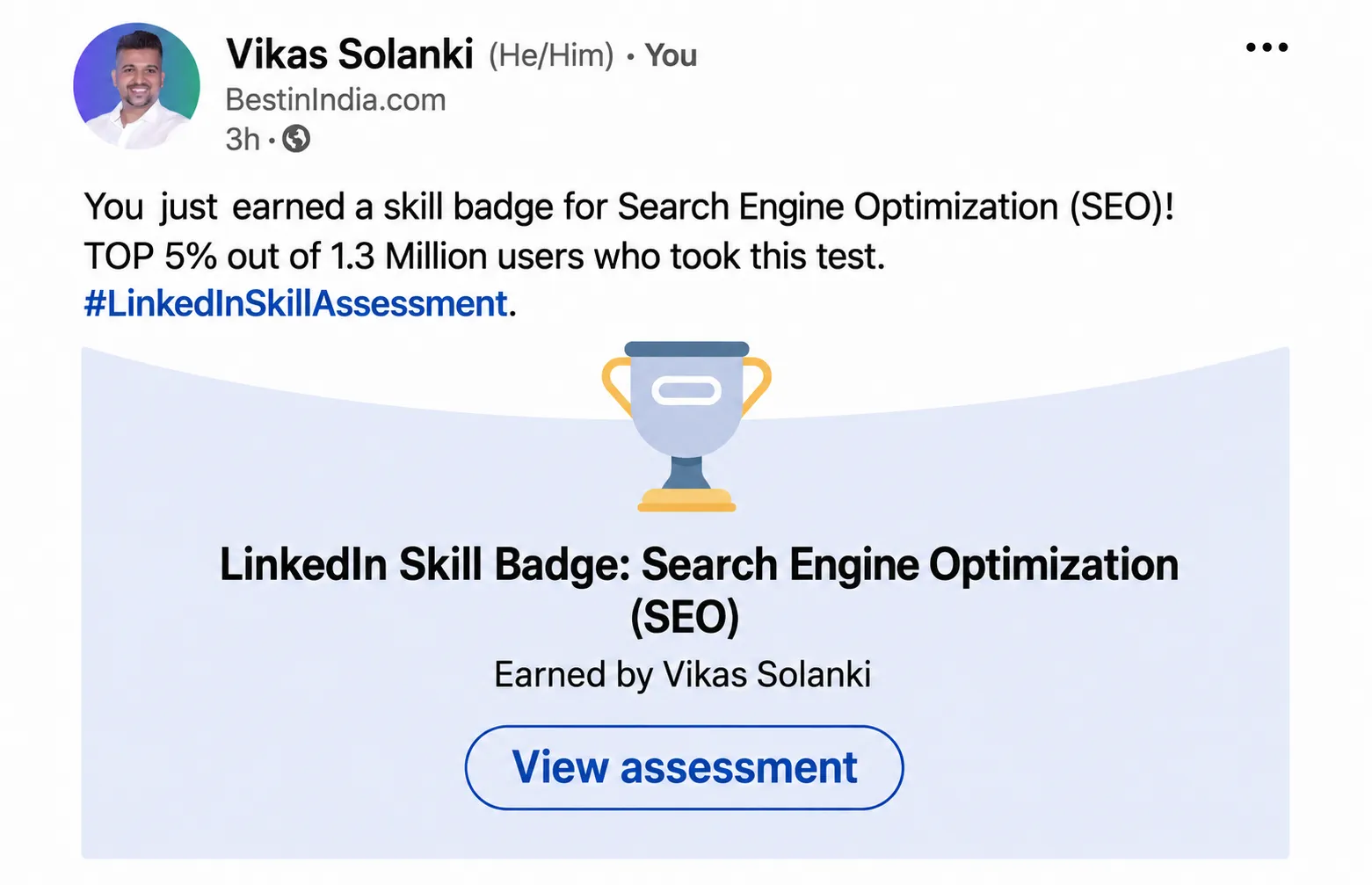
SEO assessment — top 5% of 1.3 million
A LinkedIn Search Engine Optimization skill assessment placed the result in the top 5% of 1.3 million users who took the assessment. Unlike a marketing claim about ‘years of experience’, this is a specific assessment result — and search visibility remains one of the foundations we consider when building websites.
Why Bangalore
Hubli is where I was born. Bangalore is my Karma Bhoomi — my land of action.
Bangalore is where a large part of my professional journey took shape. It is where I spent eleven years working inside demanding digital environments, learning how search, architecture, analytics, ecommerce and marketing intersect when the website is tied to real business outcomes.
That experience is now being brought directly to businesses in Bangalore — not as a promise to make every website ‘better’, but as a commitment to build the right website for the job it is supposed to do.
Who We Are For
We are not trying to be the right agency for everyone.
A website can be built for ₹25,000. It can also require many times that amount. Neither number is automatically right or wrong. The scope, complexity, competition, technical requirements, content, integrations and business objective determine what the work actually requires.
That is why we are uncomfortable with treating web design, web development or SEO as fixed gold-and-silver commodity packages. A local service business, a competitive ecommerce company and a complex B2B technology company do not have the same problem — so they should not receive the same solution simply because it fits a package.
We want to work with businesses that are willing to understand the problem, look at verifiable evidence, make informed decisions and invest in the work required to solve it properly.
The Promise
We don't want you to feel impressed on launch day. We want you to feel relieved.
Your website should make you more confident about your business — not give you another digital problem to manage.
We have seen what happens when websites are treated as showpieces, when SEO is bolted on after development, when technical decisions are made without understanding their consequences, and when clients are asked to pay for experiments that should have been thought through beforehand.
Our aim is simpler: build a website that is coherent, technically sound, understandable to search engines, persuasive to humans and stable enough to do its job.
There are businesses in Bangalore that are far more authoritative than their websites make them look. We want to change that.
Tell us what you're building.
Share what your business does and what you want the website to achieve. We will tell you honestly whether we are the right studio for it.